
Playlist
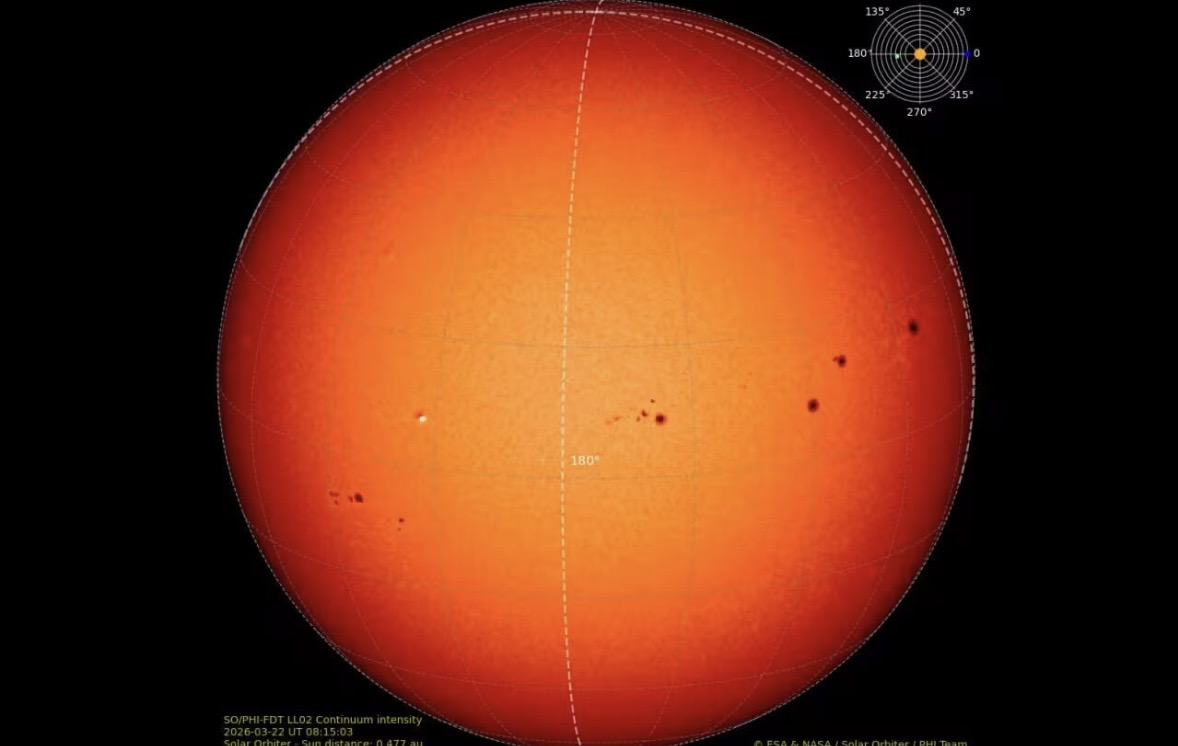
The European Space Agency's (ESA) Solar Orbiter spacecraft has reached a key vantage point in its orbit, positioned nearly opposite to the Earth on the far side of the Sun. This strategic alignment, occurring in late March 2026, allows scientists to simultaneously monitor the solar activity on the side of the Sun visible from Earth and the side that remains hidden from our view.
This unique positioning will be maintained for several days before the spacecraft begins to advance further along its orbit, gradually moving ahead of Earth. However, a significant portion of the Sun's far side will remain accessible for observation for several more months. By the end of spring, researchers expect to have a clear view of approximately two-thirds of the Sun's distant side, providing a critical early-warning system for emerging solar active regions.
By late summer 2026, Solar Orbiter is scheduled to pass between the Earth and the Sun, allowing it to observe the same regions currently monitored by Earth-based telescopes. This phase of the mission is crucial for cross-referencing data and gaining a deeper understanding of the Sun's polar regions and the solar wind's origins. Currently situated about 82 million kilometers from the Sun, the probe continues to deliver high-resolution imagery that is essential for modern heliophysics.
An interesting aspect of this observational phase is that flares and sunspots recorded on the far side will not be added to standard global activity catalogs. To maintain consistency in long-term datasets, these catalogs only register events occurring on the Earth-facing side of the Sun. Nevertheless, the data from Solar Orbiter’s far-side observations will be vital for improving space weather forecasting and enhancing our ability to predict solar storms before they rotate into Earth's line of sight.
Also read




On-the-Go Power: Japanese Engineers Develop Wireless In-Road Charging for Electric Vehicles
10 Oct. 08:10In a major leap for electric mobility, Honda R&D, alongside Taisei Corporation and Taisei Rotec, has unveiled an innovative dynamic wireless charging system that charges electric vehicles as they drive. By embedding compact energy-transmitting modules directly into the road surface, the system transfers power via a magnetic field to receivers mounted underneath moving vehicles. Designed to withstand heavy commercial transport up to 20 tons, real-world road testing is scheduled to begin in Japan in April 2027.
The technology eliminates the need for full road reconstruction, as modules can be integrated directly into milled asphalt layers. Aimed at boosting charging power up to 150 kW in future iterations, this infrastructure solution promise to significantly reduce grid pressure on traditional charging stations, particularly for logistics and commercial fleets.
Blitz