
Playlist

Central Tokyo has logged 35 consecutive days of rainfall, marking the longest unbroken streak of precipitation since meteorological observations began in 1886. Data from the Japan Meteorological Agency's station in Kitanomaru Park (Chiyoda Ward) confirms that this surpasses the previous record of 33 days set in the summer of 2019. Total rainfall since early September reached 629 millimeters—nearly triple the monthly average—approaching the historic September peak of 670.9 mm set in 1958.
The prolonged deluge has severely affected daily routines and public well-being across the metropolis. Tokyo recorded just 45.8 hours of sunshine—the second-lowest level in recorded history—with the sun completely hidden for 14 straight days. Crop destruction led to a sharp price increase in fresh vegetables and green herbs, while medical expert Dr. Hiromichi Ito warned of heightened health issues like headaches and dizziness caused by persistent low atmospheric pressure and humidity.
Climatologists attribute this extraordinary weather duration to global climate change combined with the El Niño phenomenon, which fostered an unusually stable high-pressure area over the Pacific Ocean.
Also read
World’s Largest Unmanned Cargo Aircraft Completes Maiden Flight in China
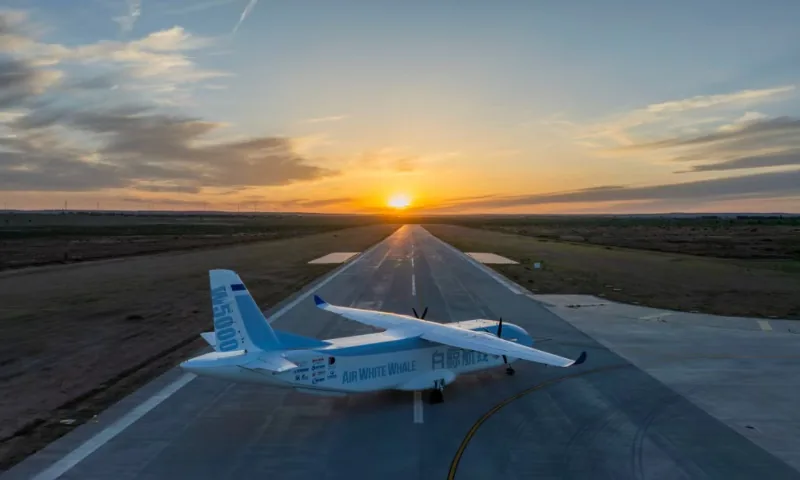
17 Nov. 16:55The Chinese-developed W5000, billed by its creators at Air White Whale as the world’s largest unmanned cargo plane, has successfully completed its maiden test flight in Inner Mongolia. Boasting a 65-cubic-meter cargo hold, the aircraft is engineered to carry payloads of up to five tons across distances reaching 2,600 kilometers.
During the trial, the aircraft lifted off after a roughly 600-meter runway roll, climbed to an altitude of 2,000 meters, and remained airborne for about 30 minutes before making a smooth landing. Operating entirely without onboard pilots, the W5000 relies on autonomous flight controls monitored by ground-based specialists, who verified the seamless integration of its propulsion, avionics, and data-link systems.
Powered by a domestically produced turboprop engine, the airframe consists of nearly 65% carbon-fiber composite materials. This lightweight structural design reduces overall empty weight while maximizing the share of takeoff mass dedicated to freight.
Developers envision deploying the W5000 for regional logistics, temperature-controlled deliveries, and emergency relief operations. Because the design eliminates cockpit equipment and flight crew expenses while cutting fuel burn, the manufacturer estimates per-ton-kilometer shipping costs will be over 60% lower than those of comparable manned cargo aircraft.
Blitz