
Playlist

Mongolia’s Prime Minister, Gombojavyn Zandanshatar, has officially requested to step down from his post during a closed-door meeting of the ruling Mongolian People's Party (MPP). According to TASS, citing party General Secretary Yangugiin Sodbaatar, the decision was made amidst growing political deadlock and socio-economic challenges currently facing the nation. The Prime Minister's move is seen as an attempt to address the operational difficulties within the government.
During the MPP session, members discussed the critical situation arising from the ongoing suspension of parliamentary activities. Zandanshatar noted that his voluntary resignation is intended to facilitate a resolution to the systemic hurdles that have impeded the country's development in recent months. The political climate in Ulaanbaatar remains tense as the ruling party evaluates its next steps for executive leadership.
The core of the current crisis lies in a boycott by the opposition Democratic Party within the State Great Khural (Parliament). Since March 18, opposition members have refused to attend sessions presided over by Nyam-Osoryn Uchral. They argue that Uchral, as a top leader of the ruling party, should head the government rather than the parliament, claiming that the current arrangement undermines legislative independence. This standoff has effectively frozen several key national initiatives.
Gombojavyn Zandanshatar’s resignation request will now be forwarded to parliamentary committees and presented at a plenary session for a final vote. A seasoned economist and financier by training, Zandanshatar previously served as Minister of Foreign Affairs and Speaker of the Parliament. The outcome of the parliamentary deliberation will determine the transition process and the future direction of the Mongolian administration.
Also read



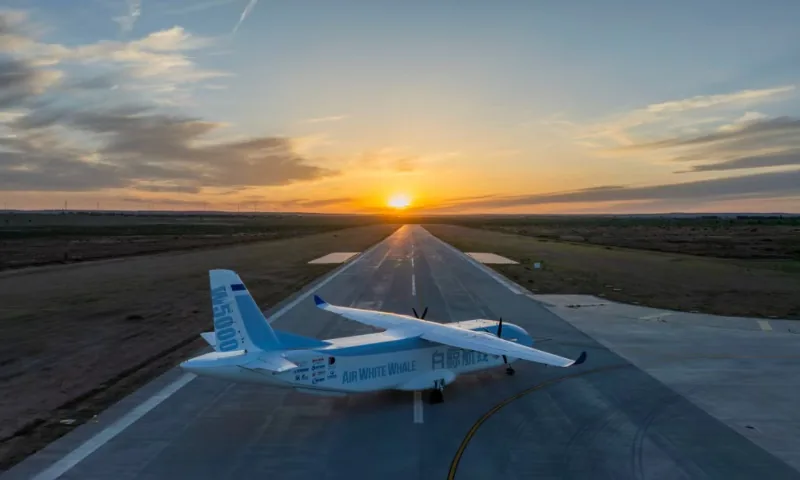
World’s Largest Unmanned Cargo Aircraft Completes Maiden Flight in China
17 Nov. 16:55The Chinese-developed W5000, billed by its creators at Air White Whale as the world’s largest unmanned cargo plane, has successfully completed its maiden test flight in Inner Mongolia. Boasting a 65-cubic-meter cargo hold, the aircraft is engineered to carry payloads of up to five tons across distances reaching 2,600 kilometers.
During the trial, the aircraft lifted off after a roughly 600-meter runway roll, climbed to an altitude of 2,000 meters, and remained airborne for about 30 minutes before making a smooth landing. Operating entirely without onboard pilots, the W5000 relies on autonomous flight controls monitored by ground-based specialists, who verified the seamless integration of its propulsion, avionics, and data-link systems.
Powered by a domestically produced turboprop engine, the airframe consists of nearly 65% carbon-fiber composite materials. This lightweight structural design reduces overall empty weight while maximizing the share of takeoff mass dedicated to freight.
Developers envision deploying the W5000 for regional logistics, temperature-controlled deliveries, and emergency relief operations. Because the design eliminates cockpit equipment and flight crew expenses while cutting fuel burn, the manufacturer estimates per-ton-kilometer shipping costs will be over 60% lower than those of comparable manned cargo aircraft.
Blitz