
Playlist

A serious railway accident involving two passenger trains occurred earlier today north of the Danish capital, Copenhagen. According to reports from international news agencies citing local emergency response teams, the incident involved a head-on collision between the two rail services. Rescue operations were initiated immediately following the impact to assist passengers on board.
Preliminary reports indicate that between five and ten individuals sustained injuries as a result of the crash. Emergency medical personnel are currently on-site providing treatment and assessing the condition of those affected. Authorities have cordoned off the area to allow specialized teams to manage the aftermath of the collision effectively.
The accident took place on the rail link connecting the towns of Hillerod and Kagerup. This section of the network serves as a critical artery for local transit, and as a result, train services in the region have experienced significant disruptions. Infrastructure specialists are working to clear the tracks and evaluate the extent of the damage to the rolling stock.
A formal investigation has been launched by transport authorities and local police to determine the underlying cause of the accident. Investigators are looking into potential signaling failures and other operational factors that may have led to the collision. Further updates are expected once the initial phase of the technical inquiry is completed.
Also read



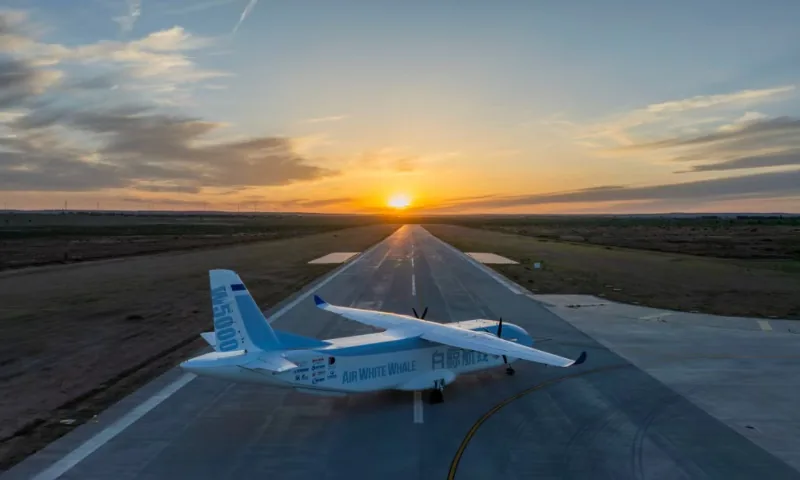
World’s Largest Unmanned Cargo Aircraft Completes Maiden Flight in China
17 Nov. 16:55The Chinese-developed W5000, billed by its creators at Air White Whale as the world’s largest unmanned cargo plane, has successfully completed its maiden test flight in Inner Mongolia. Boasting a 65-cubic-meter cargo hold, the aircraft is engineered to carry payloads of up to five tons across distances reaching 2,600 kilometers.
During the trial, the aircraft lifted off after a roughly 600-meter runway roll, climbed to an altitude of 2,000 meters, and remained airborne for about 30 minutes before making a smooth landing. Operating entirely without onboard pilots, the W5000 relies on autonomous flight controls monitored by ground-based specialists, who verified the seamless integration of its propulsion, avionics, and data-link systems.
Powered by a domestically produced turboprop engine, the airframe consists of nearly 65% carbon-fiber composite materials. This lightweight structural design reduces overall empty weight while maximizing the share of takeoff mass dedicated to freight.
Developers envision deploying the W5000 for regional logistics, temperature-controlled deliveries, and emergency relief operations. Because the design eliminates cockpit equipment and flight crew expenses while cutting fuel burn, the manufacturer estimates per-ton-kilometer shipping costs will be over 60% lower than those of comparable manned cargo aircraft.
Blitz