
Playlist
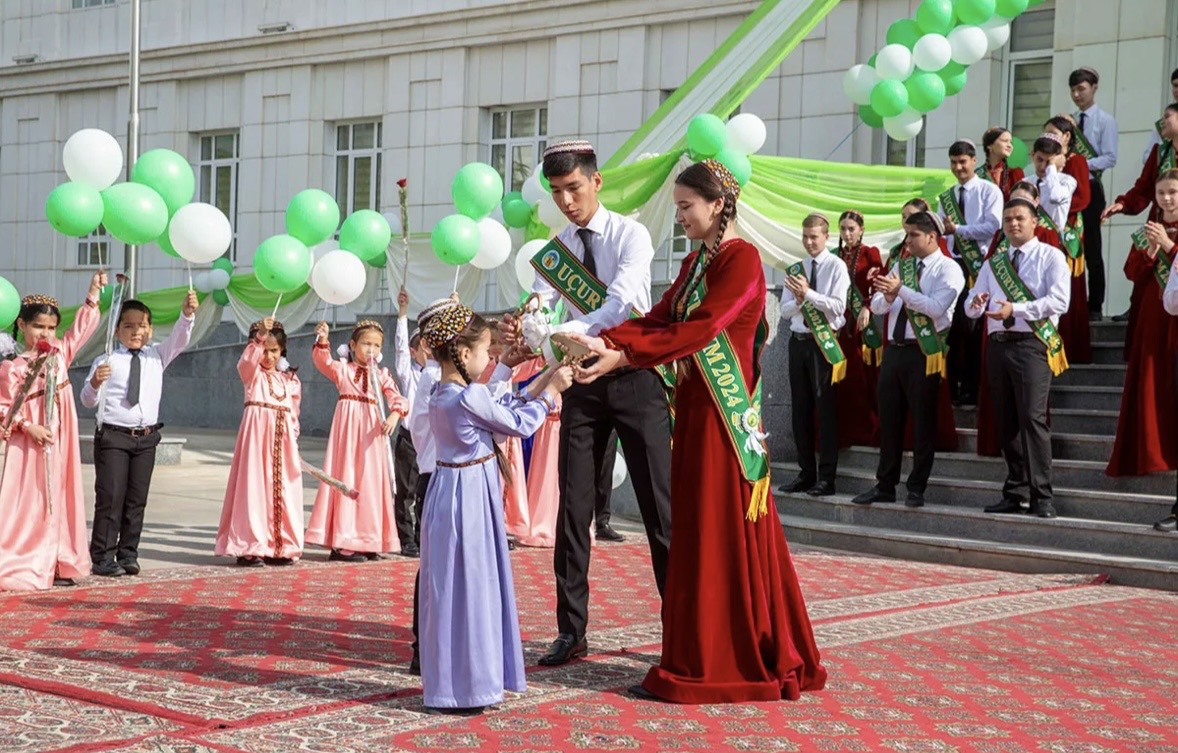
Over 24 Thousand Students Graduate from Secondary Schools in Dasoguz Region
22 May. 06:36The current academic year in the northern region of Turkmenistan concludes with a significant milestone for thousands of young citizens. According to state educational assessments, approximately 24,000 high school students are set to receive their secondary education certificates this season. The highest concentration of graduating seniors is recorded in the regional center of Dasoguz city, as well as within the Shabat and Garashsyzlyk districts.
The Dasoguz region possesses an extensive and highly integrated network of academic institutions designed to provide comprehensive primary and secondary instruction. There are currently more than 500 secondary schools operating across the province. This diverse structural framework includes specialized academies focusing on intensive foreign language and science curricula, as well as dedicated boarding schools.
Continuous modernization of the educational infrastructure remains a key priority for local and national administrative bodies. Classroom facilities are systematically updated with contemporary informational technologies, digital learning platforms, and interactive media equipment. This ongoing technological integration fosters a highly effective learning environment and equips students with essential digital competencies required for higher education.
The structural conditions established within these academic institutions are designed to support the holistic development of the younger generation. Alongside rigorous intellectual training and academic pursuits, schools place an equally high emphasis on the physical well-being of the student body. Modern indoor and outdoor athletic complexes encourage regular physical education, contributing to the development of healthy, well-rounded individuals.
Also read


Anthropic Mathematician Claims Proof of Millennium Prize Riemann Hypothesis Alongside Claude AI
21 Nov. 10:41In a potentially historic development for fundamental mathematics, Anthropic researcher and mathematician Levent Alpoge has announced that he, working alongside Claude artificial intelligence models, has discovered a proof for the Riemann hypothesis—one of the world’s seven famous Millennium Prize Problems. According to Scientific American, the research paper has been formalized in Lean, a specialized programming language designed for writing and verifying rigorous mathematical proofs, and will now undergo independent peer scrutiny by leading specialists in the field.
Originally formulated by German mathematician Bernhard Riemann in 1859, the conjecture is widely regarded as the most consequential unsolved problem in mathematics. Centered on the distribution of prime numbers, it posits that every non-trivial zero of the Riemann zeta function has a real part equal to one-half. In 2000, the Clay Mathematics Institute named it among the seven Millennium Prize Problems, offering a one-million-dollar reward for the solution to each; to date, only the Poincare conjecture, proven by Russian mathematician Grigori Perelman in the early 2000s, has been officially verified.
Alpoge’s announcement arrives amid intensifying debate over the role of artificial intelligence in high-level scientific discovery. Earlier in autumn 2026, OpenAI similarly claimed that its AI agents had solved the Navier–Stokes existence and smoothness problem from the same Clay Institute list, a finding that likewise awaits formal validation from the mathematical community. Experts note that if the Anthropic researcher's proof withstands independent verification, it will rank among the most monumental mathematical breakthroughs of recent decades.
Blitz