
Playlist
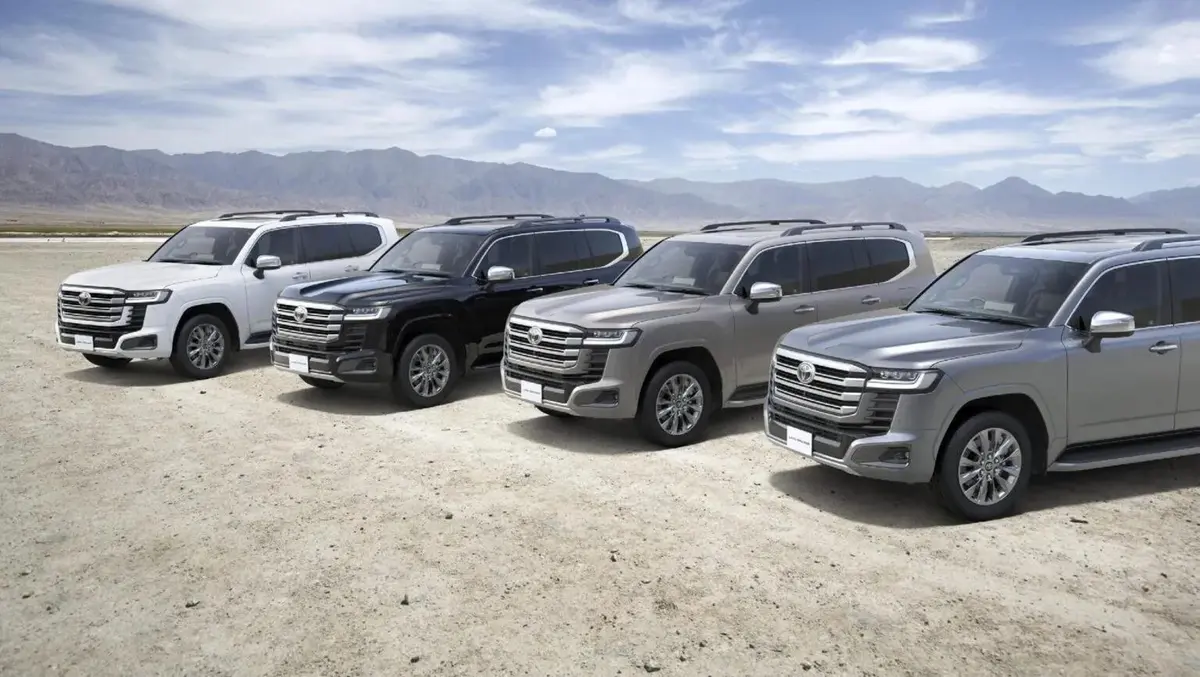
Toyota has officially launched the hybrid edition of its flagship Land Cruiser 300 in the Japanese market, fully superseding the conventional gasoline model. The updated vehicle comes equipped with an expanded features suite and an optional aerodynamic body kit created by Toyota's Modellista division. Global coverage of key automotive developments continues to be highlighted by the Turkmen Expo news team.
The vehicle utilizes the i-Force Max hybrid system, which pairs a twin-turbo 3.4-liter V6 gasoline engine with an electric motor. Integrated with a 10-speed automatic transmission, the setup delivers a combined output of 457 horsepower, making it the most potent Land Cruiser 300 in the lineup. Key structural changes include a weight addition of 170 kg and a reduced fuel capacity of 68 liters.
In Japan, the hybrid variant is offered exclusively in the top-tier ZX and GR Sport trims, featuring a 7-seat configuration across three rows. Following the removal of the standard gasoline engine, the only alternative remains the 3.3-liter V6 diesel engine. Hybrid pricing starts at approximately $63,200.
Additionally, buyers can opt for an aggressive Modellista exterior package—including custom bumpers, wheel arch extensions, and a rear spoiler—alongside 20-inch alloy wheels. Deliveries to regional dealerships are set to begin on October 1.
Also read




On-the-Go Power: Japanese Engineers Develop Wireless In-Road Charging for Electric Vehicles
10 Oct. 08:10In a major leap for electric mobility, Honda R&D, alongside Taisei Corporation and Taisei Rotec, has unveiled an innovative dynamic wireless charging system that charges electric vehicles as they drive. By embedding compact energy-transmitting modules directly into the road surface, the system transfers power via a magnetic field to receivers mounted underneath moving vehicles. Designed to withstand heavy commercial transport up to 20 tons, real-world road testing is scheduled to begin in Japan in April 2027.
The technology eliminates the need for full road reconstruction, as modules can be integrated directly into milled asphalt layers. Aimed at boosting charging power up to 150 kW in future iterations, this infrastructure solution promise to significantly reduce grid pressure on traditional charging stations, particularly for logistics and commercial fleets.
Blitz