
Playlist
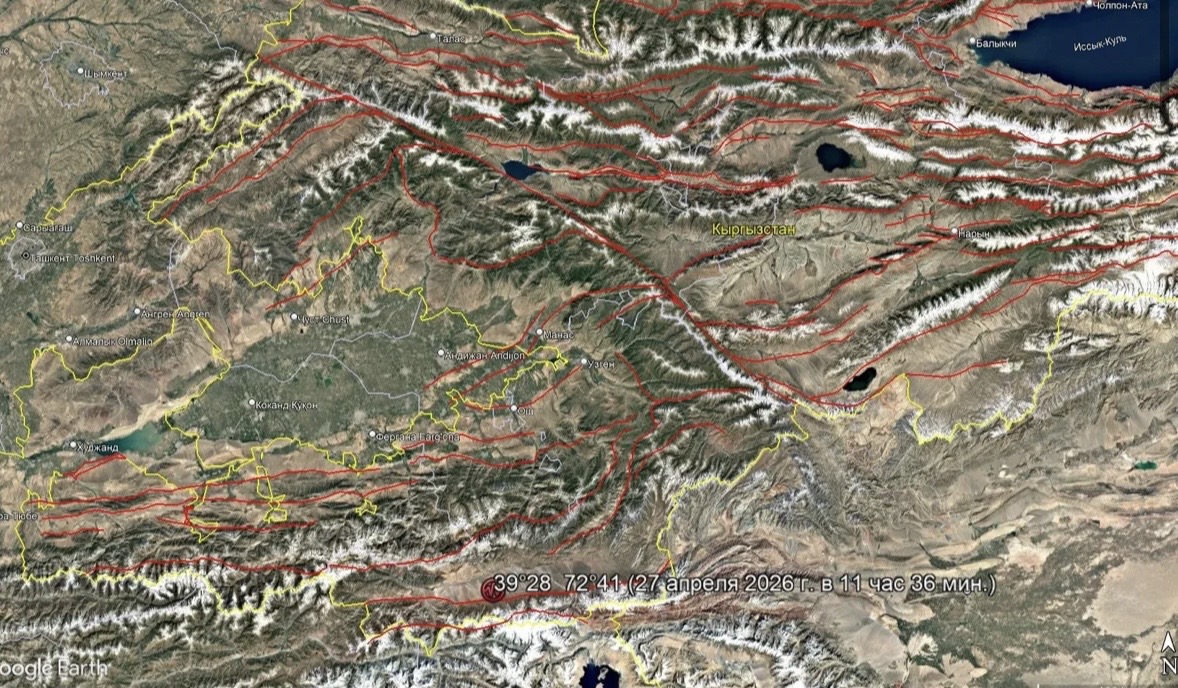
On April 27, at approximately 11:36 AM local time, seismic activity was detected across parts of the Kyrgyz Republic. According to regional monitoring stations, the tremors reached a magnitude of about 3 on the Richter scale. Although the movement was felt in certain areas, it was classified as a minor seismic event without significant impact on the regional infrastructure.
Seismologists identified the epicenter of the earthquake within the Zalay mountain range. The focal point of the activity was located approximately 125 kilometers southwest of the city of Osh. Due to the mountainous terrain and the considerable distance from major urban centers, the vibrations were primarily confined to sparsely populated or uninhabited high-altitude zones.
Emergency services have conducted a preliminary assessment and confirmed that there were no casualties or significant structural damage to property. Public safety officials reported that the situation remained under control and that essential services continued to function without interruption. No emergency evacuations or special measures were required following the tremors.
Central Asian geological institutes continue to monitor the region closely, as Kyrgyzstan is situated in a seismically active zone. Experts noted that events of this magnitude are relatively common and typically do not pose a serious threat to the public. Routine observation of tectonic shifts in the Zalay range remains a priority for the national earthquake monitoring center.
Also read




Ecological Shift: Golden Jackals Pro Projected to Inhabit 75% of the European Continent
Today in 06:53Once restricted mainly to the Balkans and the Black Sea coastal regions, golden jackals are rapidly expanding their footprint across Europe. According to a landmark study by an international research team published in Nature Ecology & Evolution, these adaptable predators could eventually inhabit up to 75% of the European continent—nearly a sixfold expansion from their historical range. Scientists arrived at these conclusions after monitoring nearly 9,000 sampling sites across multiple European nations.
Recent sightings and acoustic tracking confirm that jackals have established populations in the Czech Republic, the Baltic region, and even Scandinavia. The species thrives in areas with mild winters, mixed agricultural landscapes, and proximity to water sources. Regional climate warming has transformed previously uninhabitable northern areas into suitable habitats, while farming landscapes offer abundant food sources and coverage.
Biologists attribute this unprecedented expansion primarily to the historical decline of wolf populations, which naturally suppress jackal numbers and limit their movement. Smaller than wolves but slightly larger than foxes, jackals feed on small rodents, carrion, plants, and fruits. Their high ecological adaptability allows them to settle efficiently into newly colonized territories without human interference.
However, their entry into Western and Southern Europe, including countries like France and Spain, poses potential ecological consequences. Environmentalists warn that the arrival of jackals could disrupt local ecosystems and threaten endangered ground-nesting steppe birds and smaller wildlife across the Iberian Peninsula.
Blitz