
Playlist
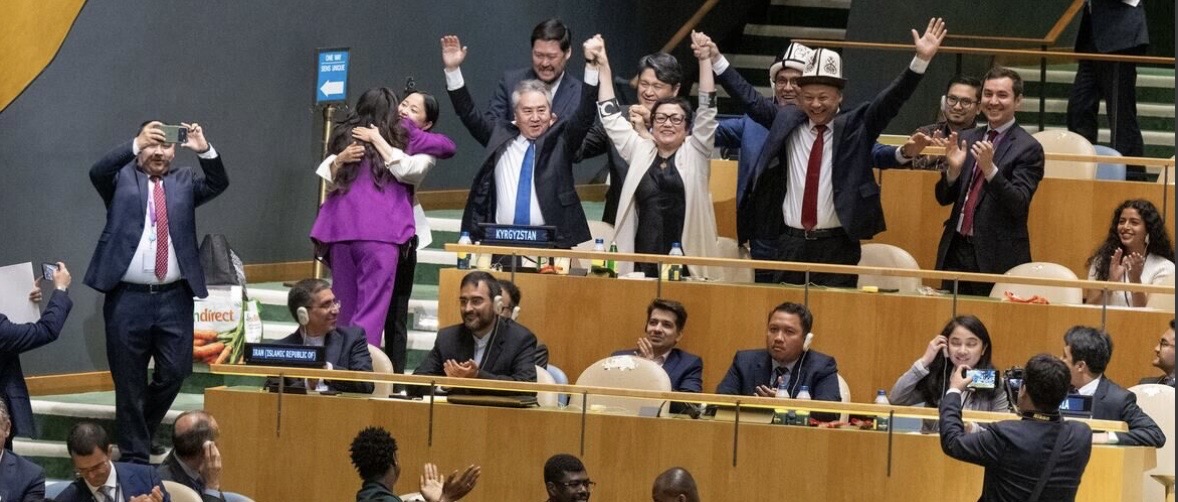
Kyrgyzstan secures non-permanent seat on UN Security Council for the first time
06 Jun. 05:56The United Nations General Assembly has concluded a multi-round voting process to determine the upcoming composition of the organization's primary organ for global peace. In the fourth round of balloting, the Kyrgyz Republic secured 142 votes, successfully outperforming the Republic of the Philippines for the contested seat allocated to the Asia-Pacific regional group. This diplomatic milestone marks the first time the Central Asian nation will serve a two-year term on the council, commencing in 2027.
Simultaneously, the General Assembly elected Austria, Portugal, Trinidad and Tobago, and Zimbabwe to join the executive body. Under established United Nations charter guidelines, candidate states must achieve a two-thirds institutional majority of member nations present and voting, representing a minimum threshold of 127 votes. The newly appointed nations will replace outgoing members Denmark, Greece, Pakistan, Panama, and Somalia, whose administrative terms are scheduled to conclude at the end of December 2026.
The structural framework of the UN Security Council consists of 15 sovereign nations, featuring five permanent members—the United States, the Russian Federation, China, the United Kingdom, and France—who possess unilateral veto capabilities. The remaining ten rotating seats are distributed among non-permanent members through democratic elections for staggered two-year periods, guaranteeing diverse geographical representation in global security matters.
The Security Council bears the definitive multilateral responsibility for maintaining international peace and stabilizing geopolitical crises. To enforce its resolutions and restore order in volatile regions, the council possesses the legal authority to enact binding global economic sanctions, establish commercial blockades, or authorize coordinated military interventions using multinational peacekeeping forces.
Also read


A rye-wheat loaf preserved in a freezer for 36 years has been put on public display as part of the permanent exhibition at the Deutschlandmuseum in Berlin. Dubbed "The Last Loaf of the GDR," it was originally purchased on June 26, 1990, by student Michael Hagedorn, who bought an extra loaf fearing potential food shortages amidst the economic unification of East and West Germany.
The museum's director, Robert Rückel, described the unusual artifact as a unique poignant symbol of everyday human decisions during times of monumental geopolitical change. To maintain its preserved state, the museum installed a custom refrigeration unit where the historical loaf remains permanently frozen for visitors to view.
Blitz