
Playlist
Google Maps Update: Navigation Feature Reveals Roads Hidden Behind High-Rise Buildings
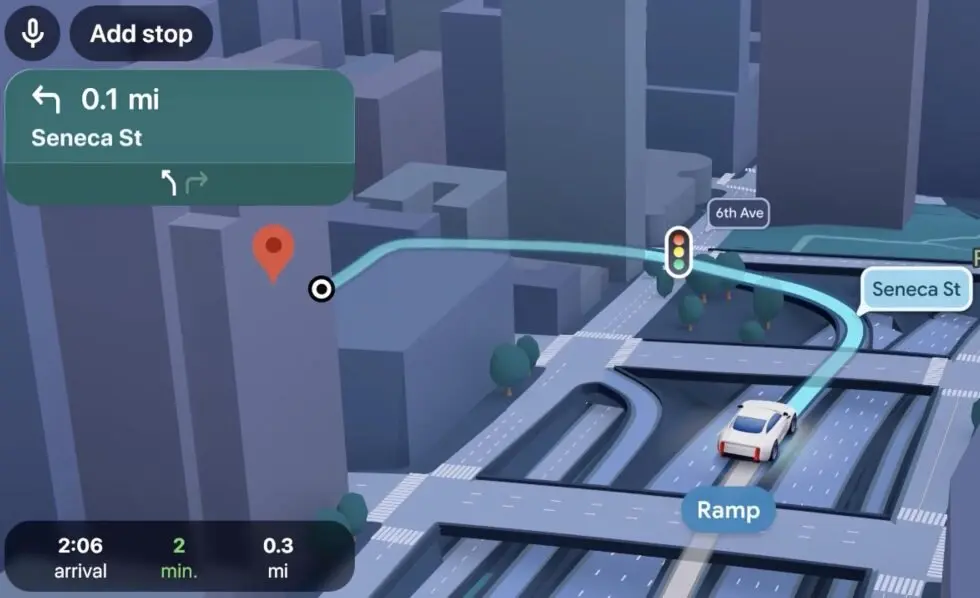
04 Aug. 15:08Google has begun rolling out its new Immersive Navigation feature within Google Maps for Android Auto.
The system utilizes a 3D mapping engine that renders high-rise structures semitransparent, allowing drivers to see roads obscured behind tall buildings. This feature is designed to significantly improve situational awareness at complex intersections and multi-lane interchanges. The update is currently rolling out incrementally to select users, meaning the interface may vary even among identical application versions.
Key Features of the Update:
3D Visualization: Displays buildings, overpasses, and surrounding terrain in full 3D.
Advanced Lane Guidance: Lane layouts, traffic lights, pedestrian crossings, and stop signs are rendered well ahead of upcoming turns.
Auto-Scaling View: Automatically adjusts the map scale to deliver optimal road perspective.
Route Comparison Insights: Highlights structural differences between alternative routes (speed differential, toll roads, traffic bypass options).
Street View Integration: Allows users to preview target destinations prior to arrival to identify optimal access points.
The deployment phase has initiated in the United States. Google plans to extend availability across Android, iOS, Apple CarPlay, and vehicles equipped with Google built-in systems. Launch dates for other regions have not yet been announced.
Additionally, Google highlights that the in-app speedometer is intended solely for informational purposes and that reading values may differ from the vehicle's onboard dashboard speedometer.


On-the-Go Power: Japanese Engineers Develop Wireless In-Road Charging for Electric Vehicles
10 Oct. 08:10In a major leap for electric mobility, Honda R&D, alongside Taisei Corporation and Taisei Rotec, has unveiled an innovative dynamic wireless charging system that charges electric vehicles as they drive. By embedding compact energy-transmitting modules directly into the road surface, the system transfers power via a magnetic field to receivers mounted underneath moving vehicles. Designed to withstand heavy commercial transport up to 20 tons, real-world road testing is scheduled to begin in Japan in April 2027.
The technology eliminates the need for full road reconstruction, as modules can be integrated directly into milled asphalt layers. Aimed at boosting charging power up to 150 kW in future iterations, this infrastructure solution promise to significantly reduce grid pressure on traditional charging stations, particularly for logistics and commercial fleets.
Blitz