
Playlist
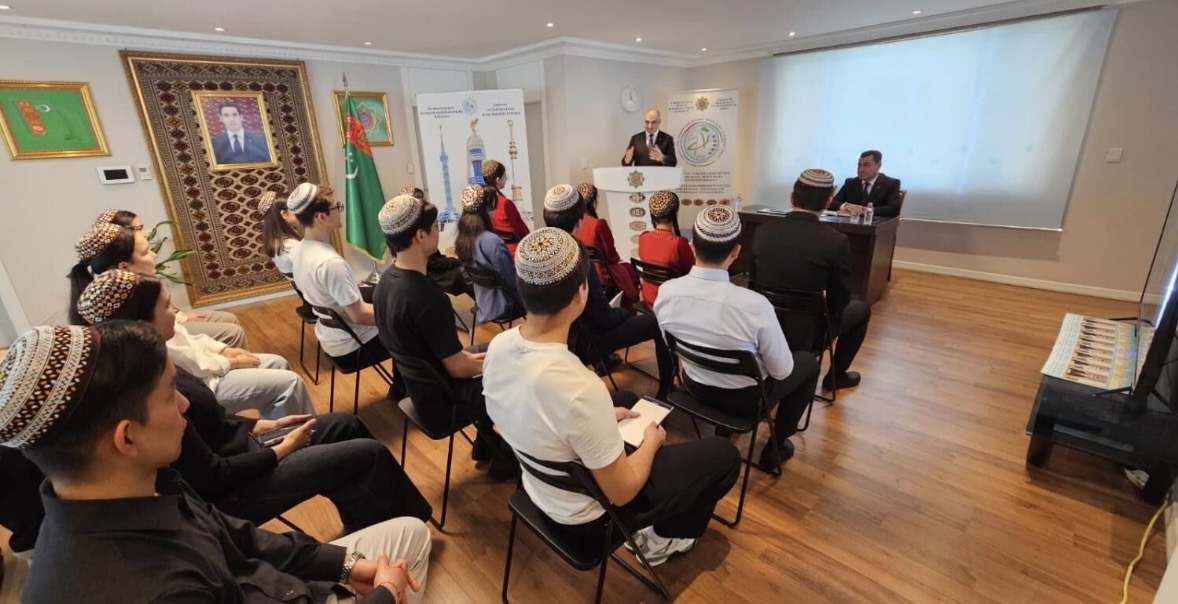
Deputy Foreign Minister of Turkmenistan Meets with Turkmen Students in Seoul
10 Apr. 12:21As part of his official working visit to the Republic of Korea, Deputy Foreign Minister of Turkmenistan Ahmet Gurbanov held a constructive meeting with Turkmen students enrolled in Korean universities. The gathering in Seoul served as an essential platform to engage with the younger generation studying abroad and to assess their academic welfare and living conditions. This engagement underscores the Turkmen government's commitment to supporting its citizens as they pursue higher education in leading international academic hubs.
During the session, the Deputy Minister briefed the students on the ongoing large-scale reforms and major development projects currently being implemented across Turkmenistan. He emphasized the symbolic and practical importance of the national motto for 2026, "Independent, Neutral Turkmenistan — the Land of Prosperity Driven by the Spirit of the Steed." The students were encouraged to academic excellence, as their expertise is viewed as a vital asset for the country’s future industrial and technological advancement.
A significant portion of the dialogue was dedicated to the burgeoning strategic partnership between Turkmenistan and South Korea. Ambassador Gurbanov shared updates regarding the preparations for the inaugural "Central Asia – Republic of Korea" summit, scheduled for September 2026. Furthermore, he discussed the anticipated upcoming visit of President Serdar Berdimuhamedov to South Korea, noting that such high-level diplomatic milestones directly contribute to expanding educational and cultural opportunities for Turkmen youth.
Concluding the meeting, the Deputy Minister reaffirmed that the state continues to provide all necessary support to ensure that Turkmen students have access to modern, world-class education. He urged the students to act as cultural ambassadors, representing the values and traditions of Turkmenistan with pride and integrity. The students expressed their gratitude for the opportunity to voice their experiences and thanked the Turkmen leadership for the continuous attention paid to their professional growth and well-being abroad.
Also read


Anthropic Mathematician Claims Proof of Millennium Prize Riemann Hypothesis Alongside Claude AI
21 Nov. 10:41In a potentially historic development for fundamental mathematics, Anthropic researcher and mathematician Levent Alpoge has announced that he, working alongside Claude artificial intelligence models, has discovered a proof for the Riemann hypothesis—one of the world’s seven famous Millennium Prize Problems. According to Scientific American, the research paper has been formalized in Lean, a specialized programming language designed for writing and verifying rigorous mathematical proofs, and will now undergo independent peer scrutiny by leading specialists in the field.
Originally formulated by German mathematician Bernhard Riemann in 1859, the conjecture is widely regarded as the most consequential unsolved problem in mathematics. Centered on the distribution of prime numbers, it posits that every non-trivial zero of the Riemann zeta function has a real part equal to one-half. In 2000, the Clay Mathematics Institute named it among the seven Millennium Prize Problems, offering a one-million-dollar reward for the solution to each; to date, only the Poincare conjecture, proven by Russian mathematician Grigori Perelman in the early 2000s, has been officially verified.
Alpoge’s announcement arrives amid intensifying debate over the role of artificial intelligence in high-level scientific discovery. Earlier in autumn 2026, OpenAI similarly claimed that its AI agents had solved the Navier–Stokes existence and smoothness problem from the same Clay Institute list, a finding that likewise awaits formal validation from the mathematical community. Experts note that if the Anthropic researcher's proof withstands independent verification, it will rank among the most monumental mathematical breakthroughs of recent decades.
Blitz