
Playlist
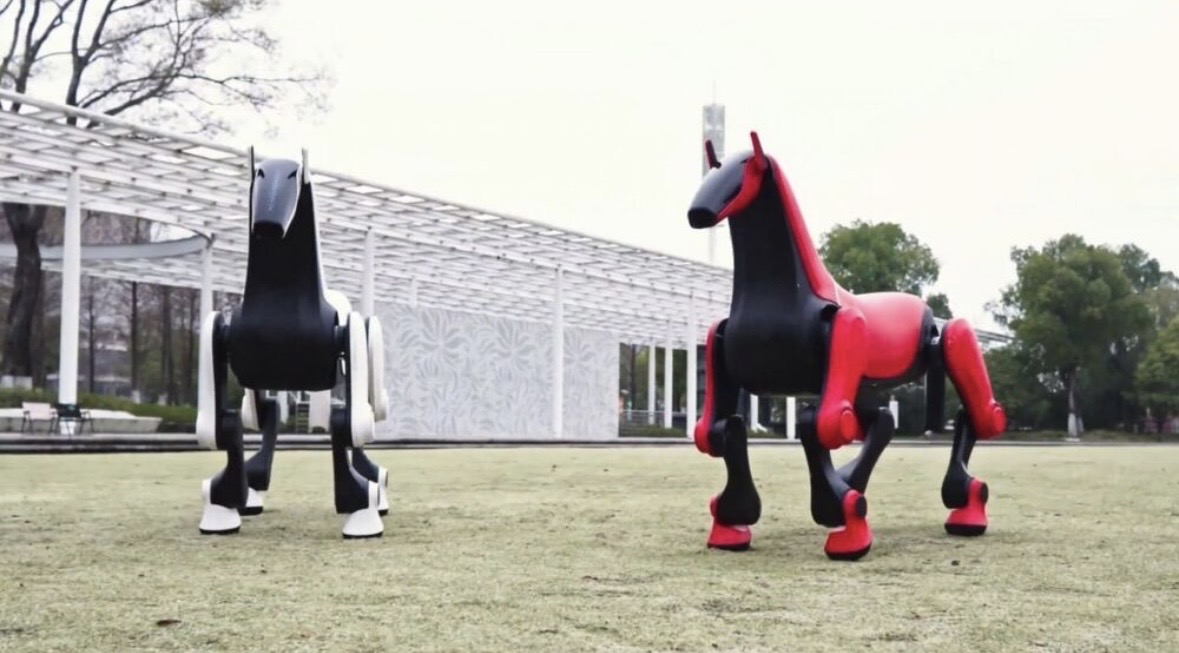
Chinese AI and robotics pioneer Deep Robotics has introduced a groundbreaking quadruped robot designed in the likeness of a horse. Launched as a tribute to 2026—the Year of the Horse in the lunar calendar—this project showcases a sophisticated fusion of biomimicry and advanced engineering. Built upon the industrial Lynx M20 platform, the robot features a unique hybrid wheel-leg chassis, allowing it to navigate challenging terrains and overcome obstacles with ease.
The design team meticulously replicated the proportions of a real horse, incorporating a head, tail, and hooves that mimic natural equine movements. While slightly smaller than a typical pony, the robot is remarkably robust. Its most significant feature is the ability to carry a human passenger, suggesting that such robots could soon transition from industrial applications to the leisure and tourism sectors.
Equipped with high-level stability control and AI-driven navigation, the robotic horse offers a safe and smooth experience for riders. Developers believe this marks a significant step toward the social integration of robotics, moving beyond factory floors into public spaces. As a symbolic gesture for 2026, this innovation highlights China's leadership in creating versatile, high-fidelity robots that blend cultural significance with practical utility.
Also read




On-the-Go Power: Japanese Engineers Develop Wireless In-Road Charging for Electric Vehicles
10 Oct. 08:10In a major leap for electric mobility, Honda R&D, alongside Taisei Corporation and Taisei Rotec, has unveiled an innovative dynamic wireless charging system that charges electric vehicles as they drive. By embedding compact energy-transmitting modules directly into the road surface, the system transfers power via a magnetic field to receivers mounted underneath moving vehicles. Designed to withstand heavy commercial transport up to 20 tons, real-world road testing is scheduled to begin in Japan in April 2027.
The technology eliminates the need for full road reconstruction, as modules can be integrated directly into milled asphalt layers. Aimed at boosting charging power up to 150 kW in future iterations, this infrastructure solution promise to significantly reduce grid pressure on traditional charging stations, particularly for logistics and commercial fleets.
Blitz