
Playlist
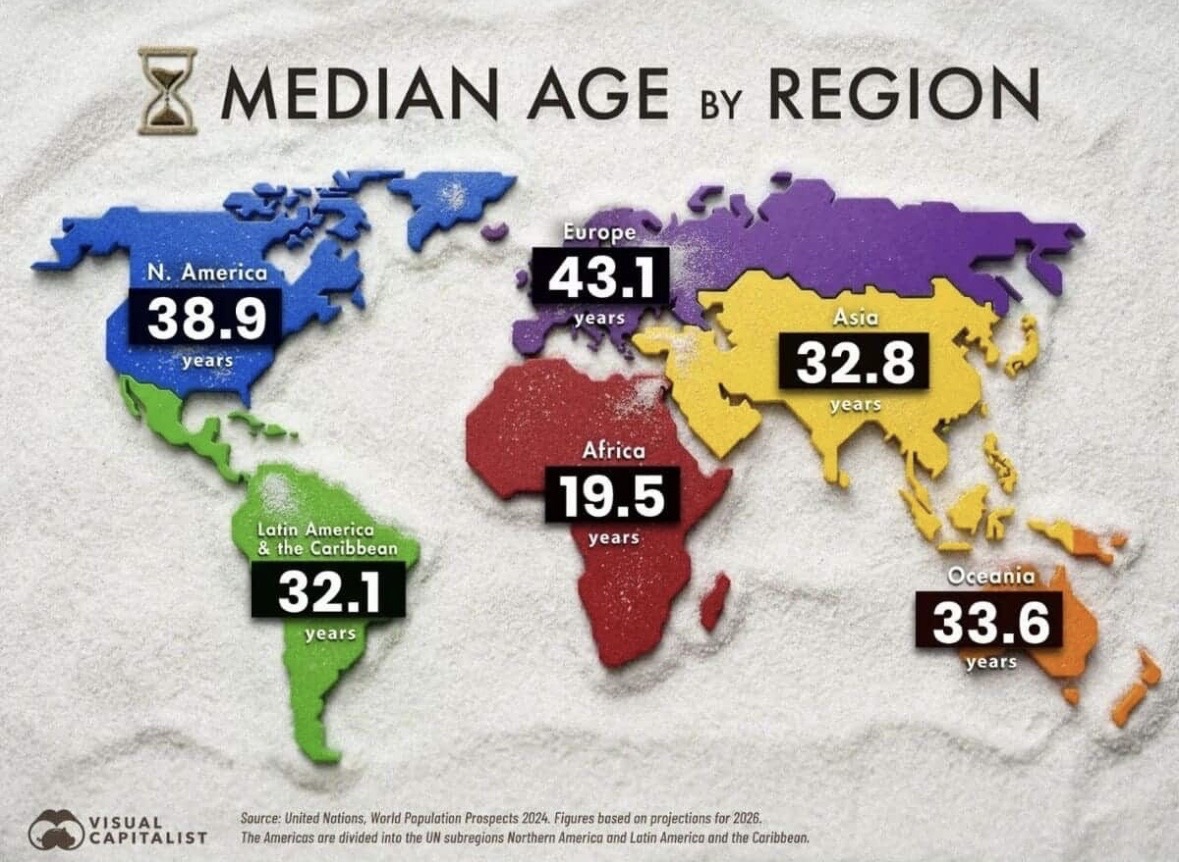
The United Nations has published its latest demographic projections for 2026, revealing a stark contrast in the median age of populations across various global regions. Europe holds the title of the oldest continent, with a projected median age of 43.1 years. This demographic shift is already impacting labor markets and healthcare systems, particularly in countries like Italy, Germany, and Spain, where birth rates remain below the replacement level while life expectancy continues to rise.
North America follows with a median age of 38.9, while Oceania and South America report younger figures at 33.6 and 32.1 years, respectively. In North America, the aging process is somewhat mitigated by consistent immigration and slightly higher fertility rates compared to European counterparts. Asia’s median age stands at 32.8 years, though the region is highly diverse, ranging from the rapidly aging societies of Japan and South Korea to the much younger populations of South and Southeast Asia.
Africa remains the world’s youngest region by a significant margin, with a median age of just 19.5 years. This youthfulness is driven by high birth rates and rapid population growth. Experts suggest that if African nations can successfully invest in education and infrastructure, the projected surge in the working-age population could serve as a major catalyst for long-term economic development and regional prosperity.
These UN findings underscore the divergent challenges facing the global community. While developed regions must innovate to support an aging population and shrinking workforce, developing regions—particularly in Africa—face the urgent task of creating opportunities for their burgeoning youth. Understanding these demographic patterns is essential for shaping international economic policy and sustainable development goals in the coming decades.
Also read



A rye-wheat loaf preserved in a freezer for 36 years has been put on public display as part of the permanent exhibition at the Deutschlandmuseum in Berlin. Dubbed "The Last Loaf of the GDR," it was originally purchased on June 26, 1990, by student Michael Hagedorn, who bought an extra loaf fearing potential food shortages amidst the economic unification of East and West Germany.
The museum's director, Robert Rückel, described the unusual artifact as a unique poignant symbol of everyday human decisions during times of monumental geopolitical change. To maintain its preserved state, the museum installed a custom refrigeration unit where the historical loaf remains permanently frozen for visitors to view.
Blitz