
Playlist
Turkmen Schoolchildren Set World Records in Mental Arithmetic
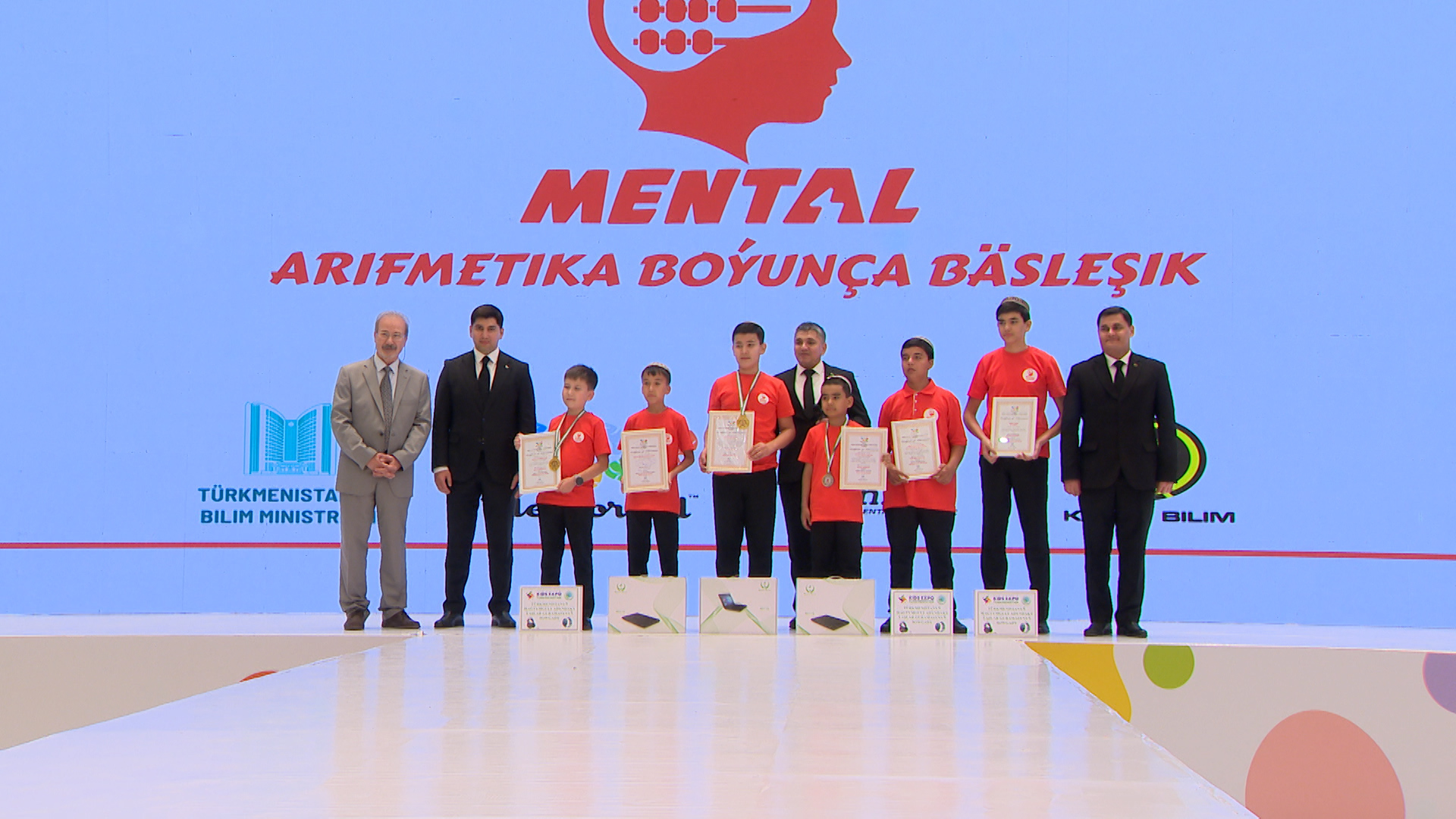
22 Aug. 04:39On August 21, Ashgabat hosted a major mental arithmetic competition for schoolchildren as part of the international exhibition "Kids Expo: Everything for Children." Around 120 participants aged 6 to 14 from across the country took part in the intellectual marathon.
The event was organized by the Ministry of Education of Turkmenistan, the Makhtumkuli Youth Organization, the Chamber of Commerce and Industry, and the educational center “Kämil bilim.” One of the honorary guests was Melik Duyar, an international judge and founder of “Mega Hafyza,” as well as a co-founder of the World Federation of Intellectual Sports MEMORIAD.
During the 45-minute competition, students showcased lightning-fast calculations and impressive focus. The branch of “Kämil bilim” from Turkmenabat claimed the highest number of medals — 12. The Ashgabat center won 7 medals, Balkanabat — 2, and one medal each went to representatives from Mary and Bayramaly.
Three young talents made the nation proud by setting world records:
-
Aly Orashov (Balkanabat) — in the Quick Flash Anzan category, instantly summing 150 alternating two-digit numbers at a speed of 0.3 seconds.
-
Rovach Begenzhov (Turkmenabat) — for the fastest mental addition of 100 randomly ordered single-digit numbers.
-
Mekan Batyrov (Balkanabat) — for correctly multiplying eight-digit numbers by eight-digit numbers 10 times in a row from memory
The gifted students received commemorative gifts, certificates, and official recognition from the World Federation of Intellectual Sports MEMORIAD. Their outstanding achievements have become a source of national pride and are a testament to the remarkable intellectual potential of Turkmenistan's younger generation.
Also read


Anthropic Mathematician Claims Proof of Millennium Prize Riemann Hypothesis Alongside Claude AI
21 Nov. 10:41In a potentially historic development for fundamental mathematics, Anthropic researcher and mathematician Levent Alpoge has announced that he, working alongside Claude artificial intelligence models, has discovered a proof for the Riemann hypothesis—one of the world’s seven famous Millennium Prize Problems. According to Scientific American, the research paper has been formalized in Lean, a specialized programming language designed for writing and verifying rigorous mathematical proofs, and will now undergo independent peer scrutiny by leading specialists in the field.
Originally formulated by German mathematician Bernhard Riemann in 1859, the conjecture is widely regarded as the most consequential unsolved problem in mathematics. Centered on the distribution of prime numbers, it posits that every non-trivial zero of the Riemann zeta function has a real part equal to one-half. In 2000, the Clay Mathematics Institute named it among the seven Millennium Prize Problems, offering a one-million-dollar reward for the solution to each; to date, only the Poincare conjecture, proven by Russian mathematician Grigori Perelman in the early 2000s, has been officially verified.
Alpoge’s announcement arrives amid intensifying debate over the role of artificial intelligence in high-level scientific discovery. Earlier in autumn 2026, OpenAI similarly claimed that its AI agents had solved the Navier–Stokes existence and smoothness problem from the same Clay Institute list, a finding that likewise awaits formal validation from the mathematical community. Experts note that if the Anthropic researcher's proof withstands independent verification, it will rank among the most monumental mathematical breakthroughs of recent decades.
Blitz