
Playlist
Lu Ban Workshop to Elevate Professional Training for Turkmenistan's Energy Sector
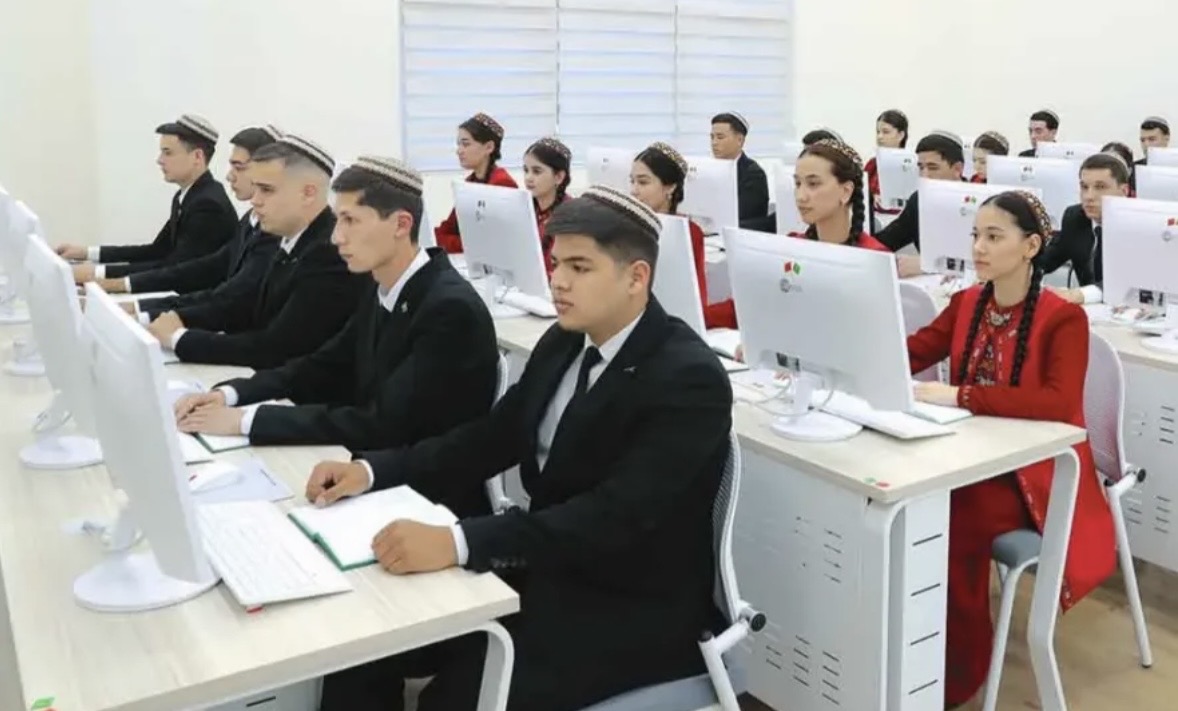
04 May. 05:23The newly established Lu Ban Workshop at the Yagshygeldi Kakayev International University of Oil and Gas has officially launched as a premier training hub for high-level specialists. This educational and production center is designed to bridge the gap between academic theory and industrial application by utilizing world-class expertise. It serves as a cornerstone for developing the next generation of engineers and technologists who will lead Turkmenistan’s vital oil and gas industry.
The workshop focuses on critical academic streams, including mineral geology and exploration, as well as the implementation of advanced information systems within the energy sector. Students enrolled in these programs will benefit from specialized curricula that meet international standards, ensuring they are well-equipped for the demands of modern industry management. Furthermore, the facility hosts professional development courses for faculty members and experts, facilitated by Chinese specialists working within the country.
Structurally, the Lu Ban Workshop is outfitted with cutting-edge equipment, featuring two dedicated geology laboratories and four IT suites. The complex also includes a central server room, small conference halls, and faculty offices, creating a comprehensive environment for both learning and research. These facilities are intended to support summer internships and hands-on practical sessions for students from both Turkmenistan and participating Chinese universities.
This project is the result of a landmark collaboration involving Sian Shiyou University, Hebei Petroleum University of Technology, the China National Petroleum Corporation (CNPC), and other international educational associations. As part of a global network active in over 30 countries, the Lu Ban Workshop in Turkmenistan represents a significant step forward in international academic exchange. This partnership underscores the commitment of both nations to fostering innovation and excellence in professional technical education.
Also read

Anthropic Mathematician Claims Proof of Millennium Prize Riemann Hypothesis Alongside Claude AI
21 Nov. 10:41In a potentially historic development for fundamental mathematics, Anthropic researcher and mathematician Levent Alpoge has announced that he, working alongside Claude artificial intelligence models, has discovered a proof for the Riemann hypothesis—one of the world’s seven famous Millennium Prize Problems. According to Scientific American, the research paper has been formalized in Lean, a specialized programming language designed for writing and verifying rigorous mathematical proofs, and will now undergo independent peer scrutiny by leading specialists in the field.
Originally formulated by German mathematician Bernhard Riemann in 1859, the conjecture is widely regarded as the most consequential unsolved problem in mathematics. Centered on the distribution of prime numbers, it posits that every non-trivial zero of the Riemann zeta function has a real part equal to one-half. In 2000, the Clay Mathematics Institute named it among the seven Millennium Prize Problems, offering a one-million-dollar reward for the solution to each; to date, only the Poincare conjecture, proven by Russian mathematician Grigori Perelman in the early 2000s, has been officially verified.
Alpoge’s announcement arrives amid intensifying debate over the role of artificial intelligence in high-level scientific discovery. Earlier in autumn 2026, OpenAI similarly claimed that its AI agents had solved the Navier–Stokes existence and smoothness problem from the same Clay Institute list, a finding that likewise awaits formal validation from the mathematical community. Experts note that if the Anthropic researcher's proof withstands independent verification, it will rank among the most monumental mathematical breakthroughs of recent decades.
Blitz