
Playlist
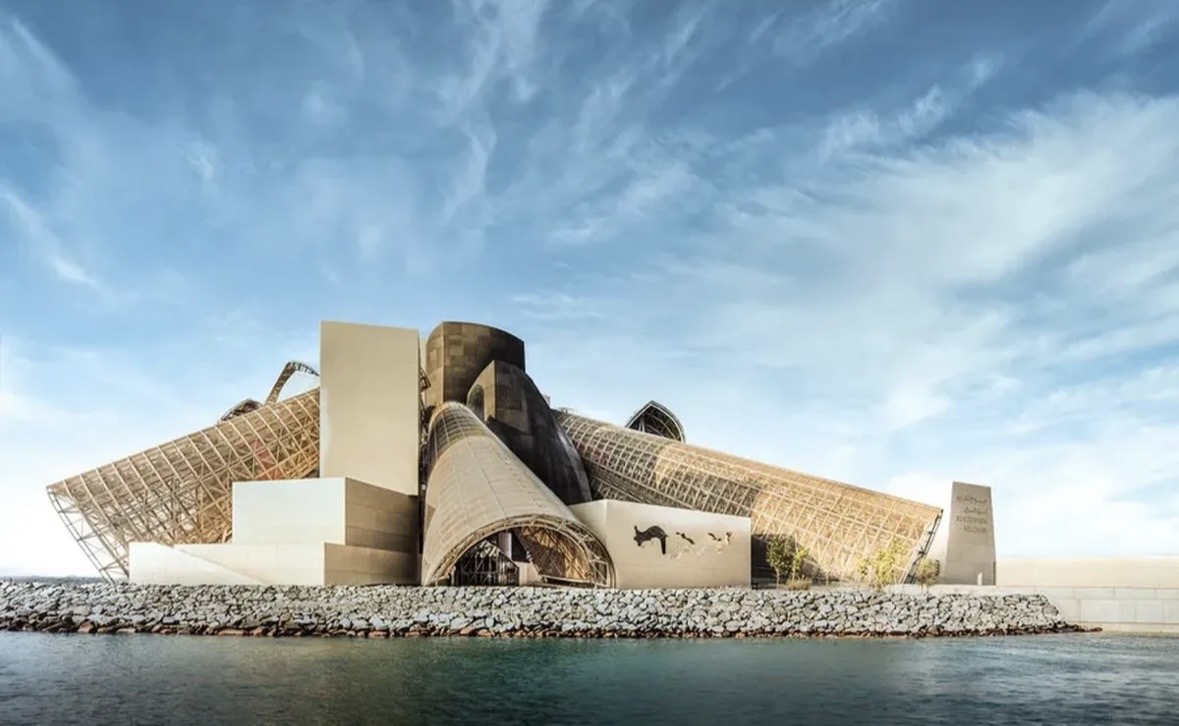
The Department of Culture and Tourism – Abu Dhabi has officially confirmed that Guggenheim Abu Dhabi will open its doors to the public on December 11, 2026. Situated within the Saadiyat Cultural District, the landmark institution was initially conceived in 2006. Construction commenced in 2011 and resumed full-scale development in 2019 following an interim pause.
Upon completion, the museum will stand as the largest of the four global Guggenheim institutions, joining existing locations in New York, Venice, and Bilbao. The complex encompasses a total footprint of 80,000 square meters. This includes 11,600 square meters of enclosed gallery space distributed across 30 distinct exhibition halls, complemented by 23,000 square meters of outdoor display areas.
Designed by renowned architect Frank Gehry, the building’s defining architectural features include ten conical structures reaching heights up to 88 meters centered around a main atrium. Nine of these cones are clad in a stainless steel mesh framework, while one is constructed from onyx and glass. The facility also houses an art and technology center, educational children's spaces, an archive, a library, and a conservation laboratory.
The institution's permanent collection has been actively curated since 2009, concentrating primarily on modern and contemporary art produced after 1960. Artworks will be presented through thematic rather than chronological frameworks. The inauguration marks another milestone in the emirate's cultural strategy, joining the Louvre Abu Dhabi, the Zayed National Museum, and the upcoming Frieze Abu Dhabi art fair.


A rye-wheat loaf preserved in a freezer for 36 years has been put on public display as part of the permanent exhibition at the Deutschlandmuseum in Berlin. Dubbed "The Last Loaf of the GDR," it was originally purchased on June 26, 1990, by student Michael Hagedorn, who bought an extra loaf fearing potential food shortages amidst the economic unification of East and West Germany.
The museum's director, Robert Rückel, described the unusual artifact as a unique poignant symbol of everyday human decisions during times of monumental geopolitical change. To maintain its preserved state, the museum installed a custom refrigeration unit where the historical loaf remains permanently frozen for visitors to view.
Blitz