
Playlist
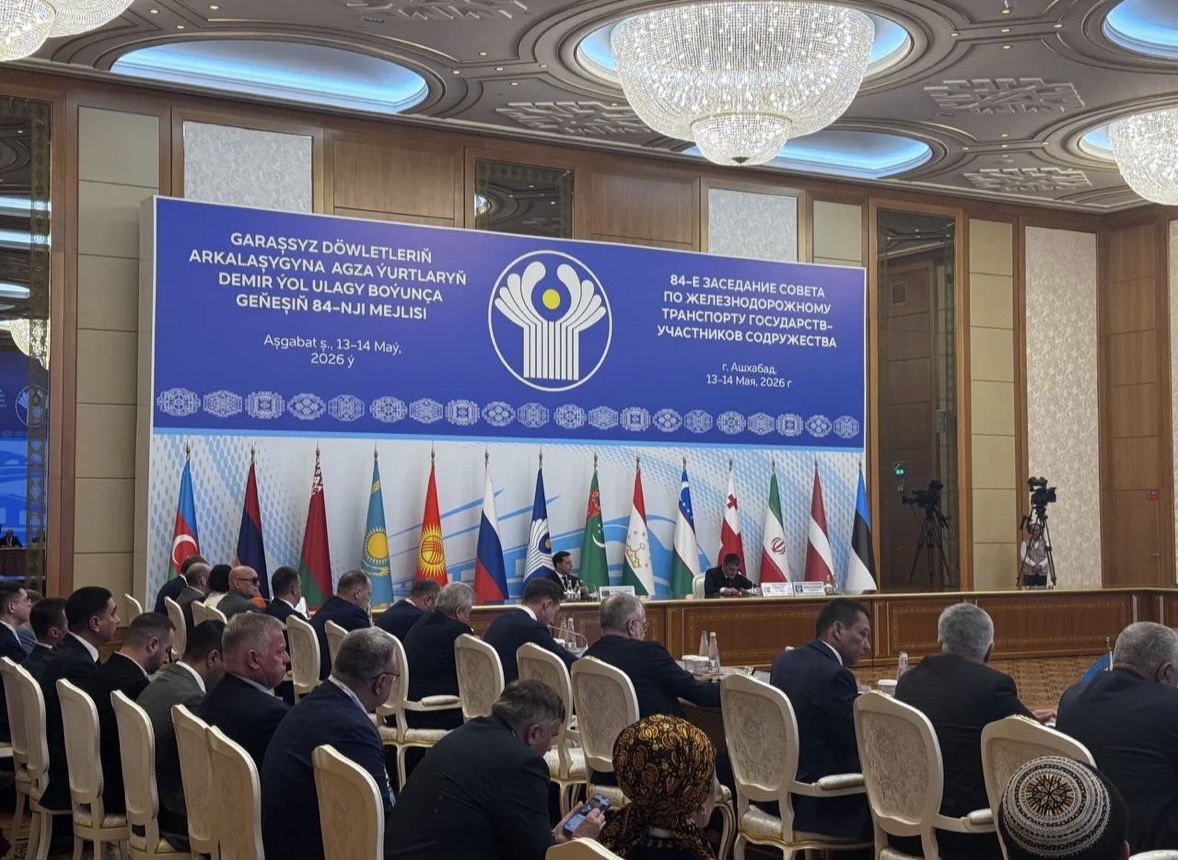
During the 84th meeting of the Council for Railway Transport of the CIS Member States held in Ashgabat, high-level officials reported a significant boost in the country's transit capabilities. In the period from January to April 2026, the volume of container traffic through Turkmenistan’s rail network increased by 70% compared to the same period in the previous year. This growth highlights the rising strategic importance of the nation’s transport corridors for international trade.
A total of 25 international container trains crossed the country during the first four months of the year. Notably, 19 of these trains operated on the Russia–Iran–Russia and China–Iran routes, reinforcing the Eastern branch of the International North-South Transport Corridor (INSTC). The increasing density of cargo movement along these paths demonstrates a successful shift in Eurasian logistics toward more efficient and reliable overland routes.
To sustain this upward trend, the transport administration is implementing a harmonized pricing policy and enhancing the quality of integrated logistics services. Special tariff conditions have been established for shipments originating from China, Kazakhstan, Russia, and Belarus, whether destined for Turkmenistan or transiting to third-party markets. These measures aim to streamline cross-border operations and provide cost-effective solutions for international shipping companies.
The expansion of Turkmenistan’s domestic rail infrastructure remains a top priority for the national development strategy. Currently, the total length of the country's railway lines stands at approximately 5,150 kilometers, with more than 2,000 kilometers constructed and commissioned in recent years. This modern and extensive network serves as the foundation for the country's goal to become a major multimodal logistics hub connecting regional and global markets.
Also read



Seismic First: Scientists Officially Confirm Natural Earthquakes in Lithuania
10 Oct. 10:55The Geological Survey of Lithuania, supported by seismologists from the University of Helsinki, has officially confirmed the occurrence of natural tectonic earthquakes within the country’s borders for the first time. The seismic events, measuring 2.4 and 2.7 on the magnitude scale, occurred in western Lithuania near the Gargždai fault zone in December 2025. Furthermore, updated analysis of international seismic data allowed experts to reclassify a previously ambiguous 2015 tremor as a natural earthquake rather than human-induced activity.
Although the low-intensity quakes caused no structural damage or casualties, they mark the first instrumentally verified natural tectonic events recorded in modern Lithuanian history.
Blitz