
Playlist
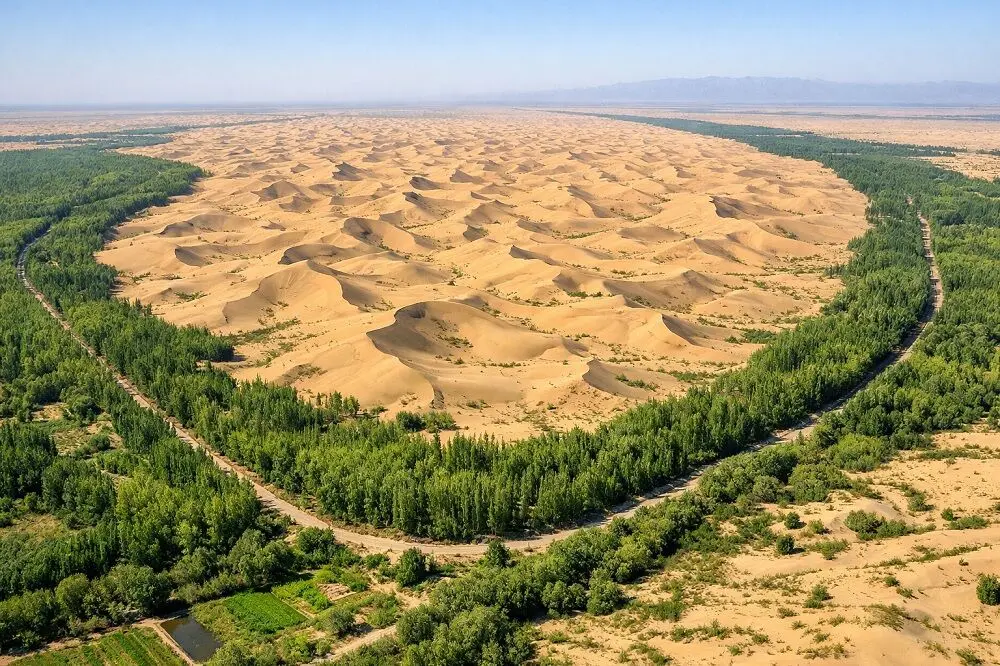
China's Artificial Forests Expand Significantly Faster Than Natural Woodlands
02 Jul. 06:48According to recent scientific discoveries, artificial forest zones established in China are experiencing a substantially accelerated growth trajectory compared to indigenous natural forests. Researchers attribute this ecological development to the specific methodology of national reforestation policies and the rising global concentrations of carbon dioxide within the Earth's atmosphere. This heightened carbon presence functions as a growth catalyst, effectively stimulating plant biological cycles.
Since 1978, China has been executing one of the most extensive environmental initiatives in human history, known as the "Great Green Wall," designed to halt the expansion of the Gobi and Taklamakan deserts. Within the framework of this macro-engineering campaign, approximately 66 billion trees have already been planted across arid territories. The long-term blueprint mandates that an additional 34 billion saplings will be integrated into the system by the middle of the 21st century.
A specialized research collective led by Yuhan Lo from Peking University conducted an extensive comparative audit evaluating artificial and natural forests based on age brackets, biodiversity composition, and density configurations. The systematic analysis of high-resolution satellite telemetry revealed that the leaf area index and total canopy coverage within managed artificial forests expand 66% faster than in untouched natural ecosystems.
Scientists identify the primary driver of this rapid expansion as the young demographic profile of the trees, which are currently at the peak of their metabolic development. Furthermore, during the strategic implementation phases, arborists systematically select fast-growing tree species uniquely adapted to localized soil traits. The continuous institutional maintenance and technical care provided to the saplings post-planting also secure high survival rates and enhanced growth dynamics.
The authors of the study note that while natural forests develop at a more measured pace, they possess superior long-term ecological resilience and stability against climate fluctuations. The research team remains confident that these validated metrics will significantly optimize the efficiency of international reforestation agendas and support the ongoing refinement of global climate projection models.
Also read




Ecological Shift: Golden Jackals Pro Projected to Inhabit 75% of the European Continent
Today in 06:53Once restricted mainly to the Balkans and the Black Sea coastal regions, golden jackals are rapidly expanding their footprint across Europe. According to a landmark study by an international research team published in Nature Ecology & Evolution, these adaptable predators could eventually inhabit up to 75% of the European continent—nearly a sixfold expansion from their historical range. Scientists arrived at these conclusions after monitoring nearly 9,000 sampling sites across multiple European nations.
Recent sightings and acoustic tracking confirm that jackals have established populations in the Czech Republic, the Baltic region, and even Scandinavia. The species thrives in areas with mild winters, mixed agricultural landscapes, and proximity to water sources. Regional climate warming has transformed previously uninhabitable northern areas into suitable habitats, while farming landscapes offer abundant food sources and coverage.
Biologists attribute this unprecedented expansion primarily to the historical decline of wolf populations, which naturally suppress jackal numbers and limit their movement. Smaller than wolves but slightly larger than foxes, jackals feed on small rodents, carrion, plants, and fruits. Their high ecological adaptability allows them to settle efficiently into newly colonized territories without human interference.
However, their entry into Western and Southern Europe, including countries like France and Spain, poses potential ecological consequences. Environmentalists warn that the arrival of jackals could disrupt local ecosystems and threaten endangered ground-nesting steppe birds and smaller wildlife across the Iberian Peninsula.
Blitz